
Last month, Prince William visited the Apricot Centre in Devon, a farm using regenerative approaches including agroforestry, rotational grazing, and other techniques designed to work with natural systems rather than against them. The conversation around regenerative farming is getting louder, and with literal royalty now championing the approach, it’s becoming harder and harder to ignore.
Yet if you spend enough time reading industry discussions, looking at the research, or speaking to the growers themselves, you'll find there’s still a huge amount of scepticism surrounding it.
Studies have found that farmers – particularly ‘lifers’ – are often dismissive, describing regenerative agriculture in terms that ranged from unconventional to completely unrealistic. A participant in one study said their grandfather would think he was "absolutely crackers" for adopting regenerative methods, while others reported being seen as "bonkers", "mad", or "nuts". Another concern was even more direct: "It all sounds great, but if it doesn't actually work, it's not going to pay the bills".
And to be fair, that's not an unreasonable position.
The question that farmers are asking themselves is this: why doesn’t regenerative agriculture work in practice? But here’s a different question: how can we get it to work better for our land?
What if, historically, we simply haven't had the tools to adapt those ideas to the realities of individual farms? What if regenerative farming *can* work, given the tools we have available to us today?
Exploring the issue
The appeal of regenerative farming is easy to understand. Research has linked the approach to improved soil productivity, long-term economic sustainability, and greater resilience, which become increasingly important when you consider that around 75% of the world's soils are degraded.
Yet regenerative agriculture still covers only around 1.5% of global farmland.
If the benefits appear so compelling, why has adoption remained so limited? The fact is that the objections are real.
Farming is shaped by practical realities rather than theory. Farmers work with different soil types, different weather patterns, different crops, and different commercial pressures. When somebody says regenerative farming won't work because their soil is too rocky, too patchy, or too difficult to manage, that concern deserves to be taken seriously. Farmers know their own land and limitations.
Historically, one of the biggest criticisms of regenerative agriculture has been that no two farms are the same. Advice that works brilliantly in one location may fail completely in another. Viewing regenerative agriculture as a ‘one-size-fits-all’ approach hasn’t been the right call. Yet until fairly recently, that widespread approach is all we’ve been able to attempt, leading to a lack of results.
So why are we posing this new question now? After all, regenerative agriculture hasn’t changed. What has changed, however, is our ability to understand conditions within individual fields.
Regenerative farming… powered by AI?
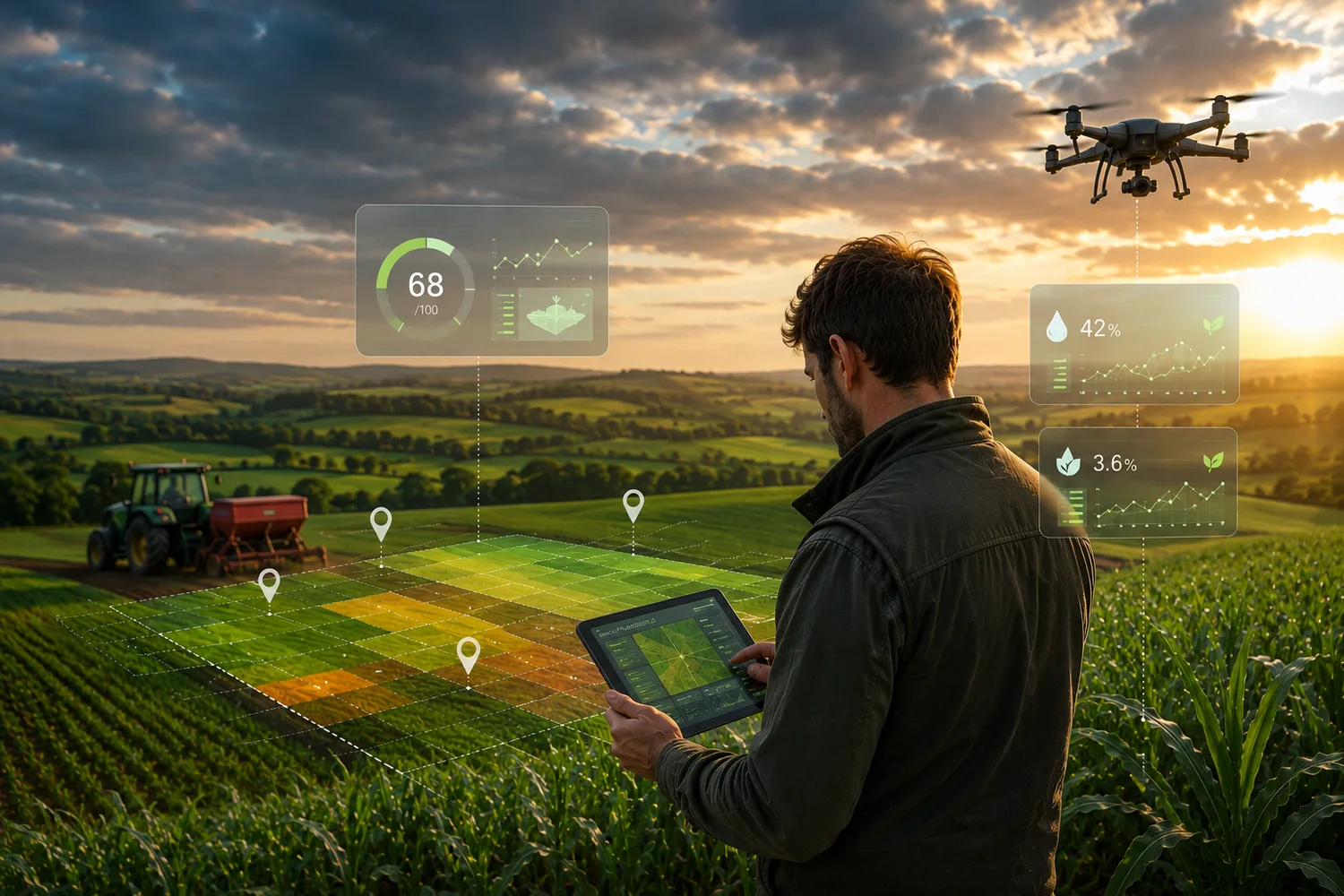
Modern monitoring tools, precision agriculture systems, sensors, remote imaging and AI-supported analysis are making it easier to understand farm-specific differences in far greater detail. Instead of treating an entire farm as a single environment, growers can increasingly identify variation within fields. They can then make smarter decisions based on actual data and the realities of their own land.
Better data allows growers to stop treating variation as a reason to give up, and start treating it as something which, when properly understood, can lead to better decision-making. Technology can help identify what’s happening in specific areas, then shape decisions around those conditions. A rocky field may need a different drilling strategy. A patchy field may need targeted intervention rather than blanket treatment. A high-risk crop may need closer monitoring before any major change is made.
And perhaps that changes the entire debate. Instead of asking whether regenerative farming works, maybe the better question is which practices work best under which conditions.
Better data doesn’t remove complexity, but it does help us understand it.
So, why can't this be done?
Regenerative agriculture is not a simple answer to a complex challenge. Farming is too varied, too localised, and too commercially demanding for that. But if healthier soils offer real long-term benefits, and if technology is giving us a better understanding of how individual fields behave, then perhaps some of the assumptions around regenerative agriculture deserve another look.
Maybe it won't work everywhere.
Maybe some approaches will prove more successful than others.
But before we dismiss the idea entirely, it feels worth asking whether regenerative farming has simply been ahead of its time up until now, and whether we finally have the tools to explore its potential properly.