
For the last few years, artificial intelligence has been getting bigger and bigger. Every new model arrives promising more capabilities, more intelligence, and more knowledge than the version before.
So, bigger must mean better, right?
In a way, yes.
It’s convenient, at least. A model that can write reports, generate software, analyse images, translate languages, answer questions, and perform countless other tasks? On the surface, it’s the dream.
But there’s a problem. Most businesses don’t actually need an AI that can do everything. In most cases, they're trying to solve a specific problem. A farmer wants to identify aphids. A manufacturer wants to spot defects. A security system wants to recognise faces. Yet organisations are being pointed towards enormous foundation models trained to solve thousands of unrelated problems.
You might be wondering what the issue is. After all, as long as a model can solve YOUR problem, why does it matter if it’s also capable of solving everyone else's? The answer is simple. These massive models have skeletons hiding in the closet: they cost more, consume more, and cause more damage.
The cost of bigger
Capability comes at a cost. Every increase in model size requires additional storage, networking, processing power and cooling infrastructure. The International Energy Agency (IEA) reports that AI-related storage systems account for around 5% of data centre electricity consumption. Networking equipment accounts for another 5%. Cooling systems can consume anywhere from 7% to over 30% of total energy demand, depending on the facility.
This poses an interesting question: if your objective is identifying pests in a crop, why use a general AI model that’s eating up huge amounts of resources? Somewhere along the way, AI developers became so obsessed with asking, ‘can we do it?’, that they didn’t think to ask whether they should.
The case for smaller AI
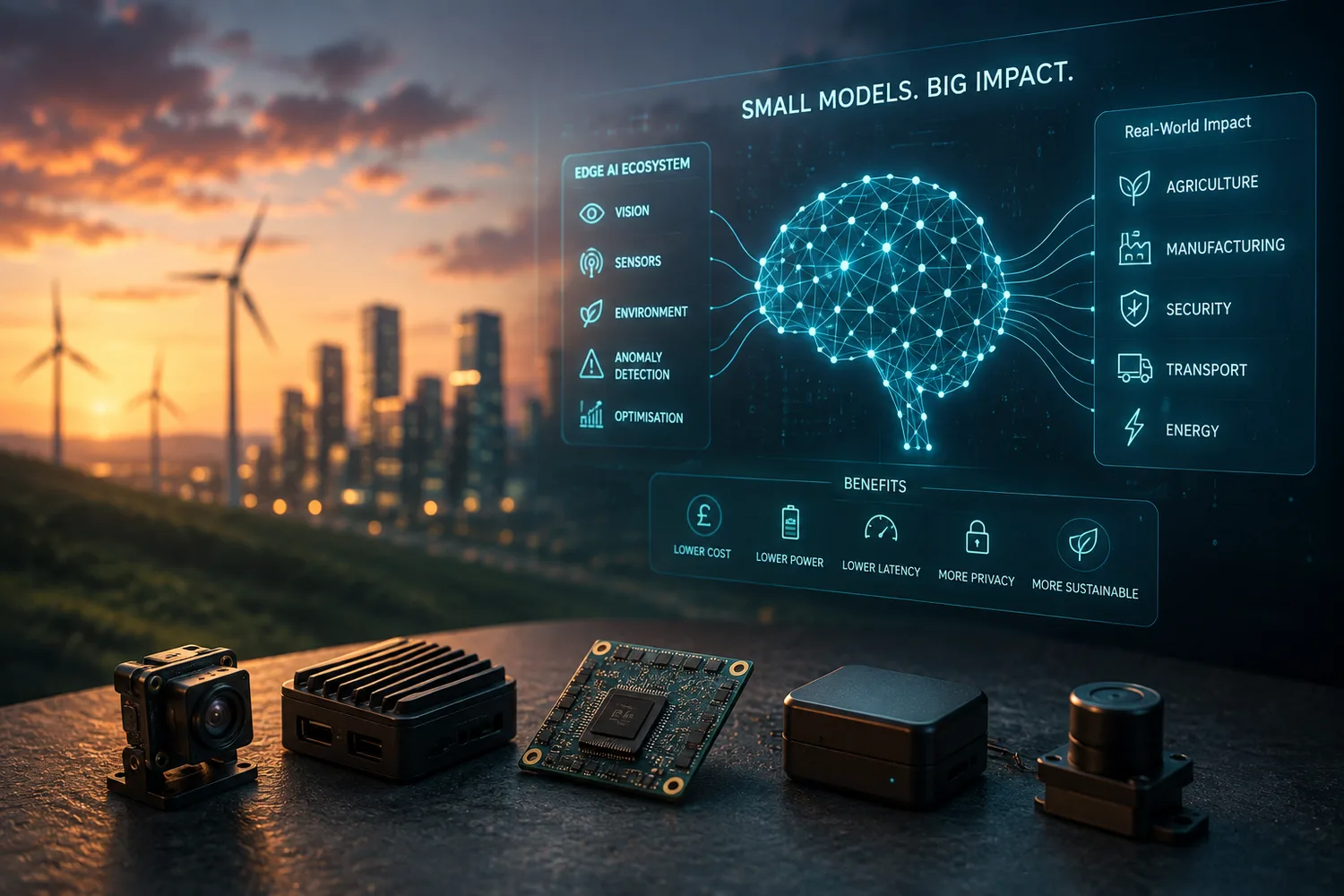
This is where Edge AI becomes quite a fascinating topic.
Smaller, more task-specific solutions challenge the idea that intelligence must live inside enormous data centres. Instead, intelligence is pushed directly onto the ‘edge’ device collecting the information.
For example, a camera processes images, a drone identifies crop damage, and a sensor monitors soil conditions. So, instead of relying on expensive infrastructure and specialist hardware, organisations can build smaller, highly focused models that consume less power, require less connectivity, and run on dramatically cheaper devices. By stripping away everything that’s irrelevant to the task, the result is often faster, cheaper, more reliable and more sustainable.
The wider market agrees. The global edge computing market is expected to grow from approximately 658.1 billion USD in 2026 to 1.87 trillion USD by 2031, representing annual growth of more than 23%.
Small doesn't mean limited
You might be thinking that niche, specialised AI will ultimately have the same issues. After all, while we can build one giant model to do it all, we’ll need thousands upon thousands of smaller ones to carry out individual tasks. And with that come the same cost and resource problems as LLMs.
Or do they?
What’s important to remember is that ‘small and specialised’ doesn’t necessarily mean limited.
In fact, these smaller models are increasingly being designed as dual-use technologies, which means their specialist capabilities can be applied to both civilian and military situations.
Take soil analysis, for example. In agriculture, tools that report on soil moisture and compaction can improve crop management. These same tools can be utilised in defence, with similar information helping to determine whether terrain is suitable for vehicles and equipment. The exact usage of the model may change, but the underlying capabilities and intelligence remain remarkably similar overall.
The same principle applies to drones, cameras and sensors. Their job is not to understand the entire world, but to recognise patterns, identify anomalies, and highlight information that requires attention. When multiple specialised systems work together, combining their outputs through sensor fusion, they can provide a richer and more useful picture than a single model attempting to do it all.
A different future
AI progress has often been measured by how big it’s becoming. But maybe a better criterion of success is looking at how small we can make AI while still producing the same – or better – results.
What if the future is thousands of smaller models, each designed to solve a specific problem, consume minimal resources, and deliver practical value exactly where it’s needed?
That future may not generate the same dramatic headlines as the latest foundation model. But for most organisations, it’s likely to be far more useful. And for the planet? It could be what saves it.