
Small agri-food businesses already know how tight the numbers are. So when people talk about AI, automation, sensors and predictive tools, the first response is rarely excitement. More often, it’s: what will this actually give us back? And that’s exactly the right type of question to be asking.
Beef farmers have reported profit equating to just 0.03% of the retail pack price for burgers, while cereal growers' profits are sometimes so small they’re considered negligible. Add an ageing workforce – the average UK farmer is 59 – and it’s easy to see why new technology is often treated with caution.
If a tool cannot show a clear return, or it’s asking for more tech know-how than farmers can give it, then we can all understand why automation is not given much thought in the agricultural world.
The yield myth
The scepticism is made all the worse by systems that have not delivered in the past. For years, new tools and techniques have been sold on the promise of increasing yield. Bigger output. Higher volume. More from the same land. But when margins are already razor-thin, producing more doesn’t automatically mean earning more. If the extra yield comes with higher fertiliser costs, more water usage, more labour or more expensive inputs, the numbers can quickly stop making sense.
And that’s one of the biggest problems in agri-food: the idea that yield automatically equals profit.
Yield matters, obviously. But it only tells you what came out of the land. It doesn’t tell you what it cost to get there. If inputs cost more than the return, the business has still lost money.
The thinking needs to shift.
The goal shouldn’t simply be greater output. It should be farming more intelligently to improve margins, rather than volume alone. This is where AI and automation earn their place.
The data problem
Believe it or not, farming is actually one of the best prepared sectors for AI. It might sound strange for an industry that’s more traditional, but the fact is that farmers are not short of information.
Modern machinery tracks seed rates, fertiliser use, crop density, soil conditions, moisture levels, timings, yield maps and fuel use. The data that AI tools need already exists. It’s there for us to use.
The problem is the quality of it.
If people don’t understand the value in data, it becomes unreliable. Readings get skipped, and information gets entered roughly because everyone is busy and nobody has explained why it matters. Bad data = bad outputs. And then farmers wonder why the tech hasn’t produced anything useful.
Before automation can deliver real value, the data itself has to be treated seriously.
Better predictions, better decisions
Once the data is reliable, the benefits become much more tangible.
Take fertiliser, for example. If it’s applied just before heavy rain, a large amount of the investment can be washed away before it’s done the job. That’s bad for business and bad for surrounding waterways.
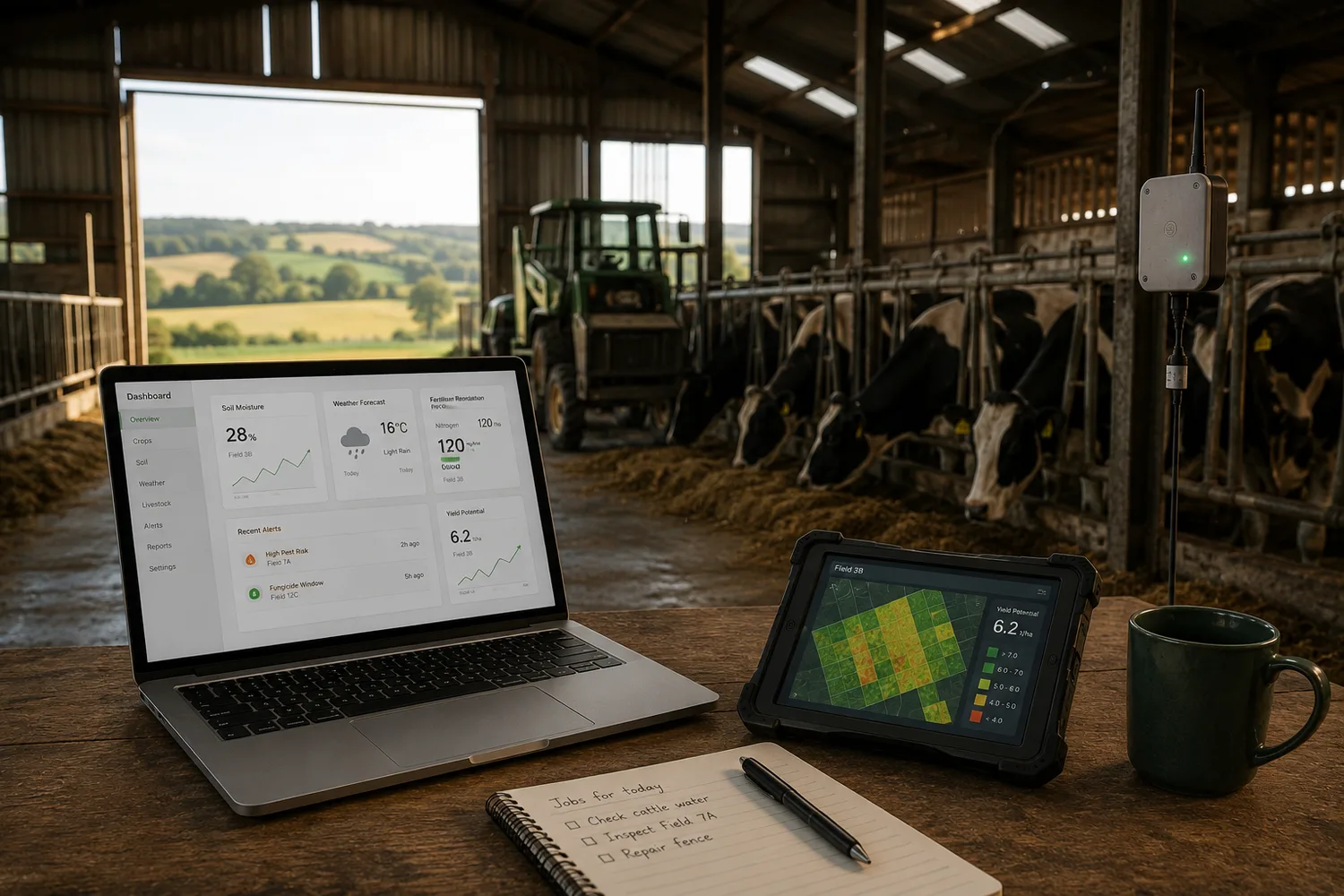
Now imagine combining soil moisture sensors with local weather forecasts. Instead of relying purely on routine or instinct, the system can flag that rain is likely. The same applies to fungicide. In a wet season, fast action may matter. In a dry spell, the same treatment may equal unnecessary spend.
Pest and disease detection is another clear example. If aphids threaten a high-value crop, automated monitoring can help identify early warning signs before the damage becomes far more expensive.
Technology that supports instinct
Technology shouldn’t walk onto a farm acting like it knows more than the people who have worked that land for decades. A farmer’s instinct, experience and local knowledge still matter. But it should be able to support that knowledge, and empower farmers to make smarter, better-informed decisions.
After all, farming is changing. Climate volatility, rising costs and tighter margins mean old assumptions are under pressure. Ignoring modern tools because “we’ve always done it this way” is becoming harder to justify. Improving profit margins means adapting to shifting landscapes.
Clever farming, not complicated farming
We know that small agri-food businesses don’t need technology that makes life harder. They need tools that help protect margins, reduce waste and support better decisions under pressure. That means moving beyond the yield myth and treating data as something that can deliver real value.
The Tekh founders are based in Lincolnshire, the heart of farming, so we not only see great potential and opportunity, we’ve seen first-hand the difficulties that farmers face. That’s why we’ve committed to continue reinvesting profits into socially beneficial projects, with a particular focus on the agriculture sector.
It’s smart to be cautious of AI. Especially “fashionable” solutions that are bright and shiny but fail to bring anything to the table. In agriculture, considered integration is the key to clever farming, better timing, quality information, and healthier profit margins.