AI is the word of the decade. Everyone’s talking about it. Everyone’s excited by it – on some level, at least. And now the early ‘what if’s’ are turning into real, day-to-day tools. Even the more futuristic use cases no longer feel that far out of reach.
So naturally, the question becomes: how far can it go?
But that intrigue comes with a catch. As AI gets more powerful, it also gets larger, heavier, and far more resource-hungry. And it is only getting bigger. We’ve got bigger models, bigger datasets, and more infrastructure to support it all. It looks impressive, sure. And it feels like progress. But impressive doesn’t always mean useful, and it definitely doesn’t always mean responsible.
At some point, you have to pause and question whether bigger is actually better, or whether we’re building these gigantic systems just because we can.
Explosive AI
For the first 60 years of AI development (yes, it really has been around as long as that!), the computing power used to train models doubled around every 20 months. But since 2010, that’s dropped to about every six months. Training a massive large language model now involves tens of thousands of powerful GPUs, consuming significant energy. Some use between five and eight times more power than standard processors. When you consider this alongside forecasts predicting global power demand from data centres could rise by up to 165% by the end of the decade, it’s clear we’ve got a problem.
Why? Because training large models increases carbon emissions. Growth in data centres drives demand for storage, cloud infrastructure and hardware. Together, this means more resource use, more waste, and more environmental pressure.
So should AI be avoided? No. But it does mean we should question what we’re being told.
At Tekh, we don’t believe that big AI is automatically the right answer.
Shrinking AI
There’s another way to approach AI. Instead of scaling everything up, you scale it down.
Edge AI means running models on low-power CPUs instead of relying on high-energy GPUs and central cloud systems. Processing happens locally, on the device, rather than being sent back and forth to a data centre. And given that moving data can account for up to 84% of dynamic energy consumption in standard AI systems, that’s key: Edge AI removes inefficiency.
The challenge is making models small enough to run locally without losing effectiveness, but it’s entirely possible. In fact, research from the University of Edinburgh found that ‘shrunk’ models using less memory could outperform larger versions on tasks such as maths, science and coding, without affecting reasoning time.
Evidence like this shows that smaller models don’t have to be a compromise; they can actually be more efficient and more practical.
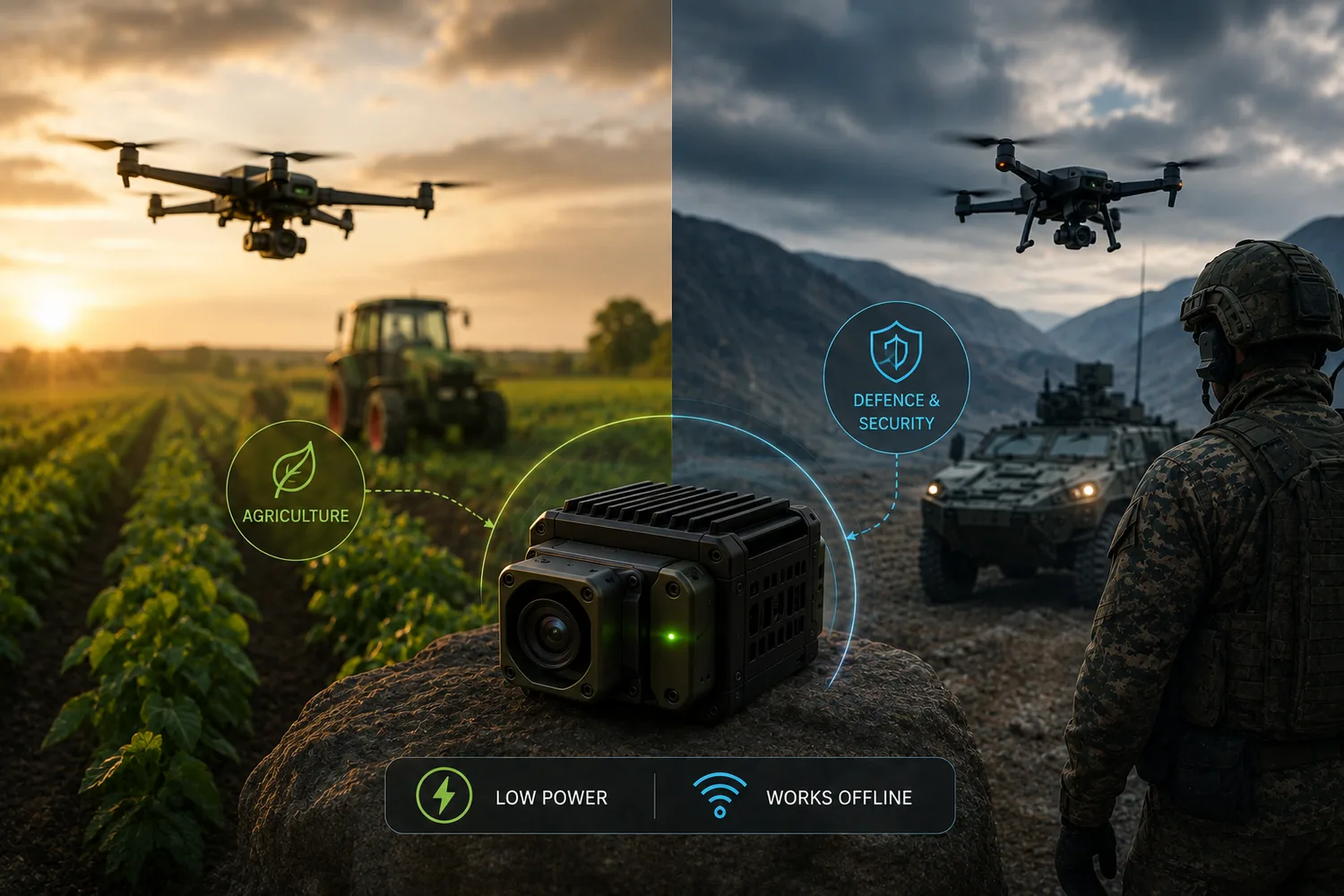
*Case Study: Here at Tekh, we’ve worked on this exact problem with the Ministry of Defence, following early work linked to the RAF. The approach challenged the assumption that serious AI requires more power. The result was a system that runs on low-power hardware and can be deployed on a drone, capable of analysing its surroundings and operating autonomously without needing a GPU.*
One technology, two opportunities
Even when AI is made smaller, it still has an impact. It still requires energy and investment, and that’s something we’re never going to be able to eradicate entirely. But what we can change is how much value that investment delivers.
Dual-use technology refers to tech that’s been developed for military and defence purposes, but can also be applied in civilian sectors – and vice versa. Ultimately, it’s about extending the value of what we create. A system built for one purpose should be capable of solving more than one problem.
Dual-use AI forces a more thoughtful approach to development. Instead of building technology for one narrow use, then starting from scratch somewhere else, the same core system can be adapted, tested and improved across different settings. That means fewer duplicate projects, less wasted resources, and more innovation carried forward. The impact of building the technology is spread across more outcomes, rather than being locked into a single application.
*Case Study: Looking again at our drone work with the MoD, we developed a technology that can easily be repurposed for civilian use, particularly within the agricultural sector. Imagine low-power drones being used to scan fields, identify weeds, and monitor crop health, without relying on heavy infrastructure. This tech has the power to reduce manual work and limit the need for large-scale chemical spraying.*
Smaller, smarter, more useful
AI does not need to keep getting bigger to improve.
Better can mean smaller, more efficient, and more focused. It can mean building systems that work in real conditions, not just controlled environments.
At Tekh, we’re not asking the expected question: how big can AI get?
We’re asking something different: how useful can AI be?